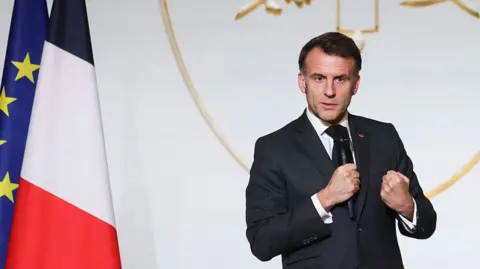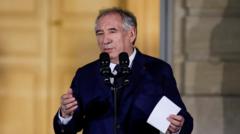
Centrist political veteran François Bayrou has been appointed as France's new Prime Minister by President Emmanuel Macron amid ongoing political turbulence. Acknowledging the "Himalayan" challenge ahead, the 73-year-old leader committed to addressing the nation's deficit and public debt, which he labeled as both a moral and financial issue. During his inaugural remarks, Bayrou emphasized, "Passing it on to one's children is a terrible thing to do," highlighting his focus on fiscal accountability.
The appointment comes in the wake of significant instability within the French government, as Bayrou succeeds Michel Barnier, who was ousted by MPs just nine days prior. Barnier's attempts to address budget cuts and deficit reduction were met with resistance, leading to his downfall. The new Prime Minister arrives as tensions run high, with 61% of voters expressing concern over the current political situation, according to recent polls. Socialist regional leader Carole Delga criticized the ongoing turmoil as reminiscent of a "bad movie," while Far-left France Unbowed leader Manuel Bompard described the situation as a "pathetic spectacle."
As Macron's fourth Prime Minister this year, Bayrou’s task will center on crafting a stable government without triggering a similar fate as his predecessor. Observers note that the far-left LFI party has already threatened to push for a vote of no confidence. Bayrou's challenge will be twofold: forming a government while garnering cross-party support amid a backdrop of political stalemate that arose after Macron's snap elections following disappointing results in June's EU elections.
Political factions, ranging from the center-left to far-right, are poised to influence Bayrou’s agenda. The Socialists and Greens have expressed willingness to collaborate but are demanding a left-aligned vision. Greens leader Marine Tondelier openly rejected Bayrou as an acceptable candidate, stating, "I told you I wanted someone from the left and the Greens." Meanwhile, National Rally MP Sébastien Chenu mentioned that if Bayrou is to address pressing issues such as cost of living and immigration, he might find allies in their party.
Bayrou’s immediate priority will be to navigate these complex relationships and ensure a cohesive cabinet that can withstand the scrutiny and challenges ahead. Michel Barnier, before leaving office, acknowledged the severe condition of the nation, describing it as "unprecedented and serious."
As the political landscape shifts, Bayrou's ability to build consensus will be vital. Having already engaged with leaders from various political parties—including center-left factions—his success hinges on finding common ground without succumbing to the divisive nature of French politics. With a backdrop of economic challenges and public dissatisfaction, Bayrou's appointment marks a pivotal moment for France in its quest for stability amidst uncertainty.