
In brief
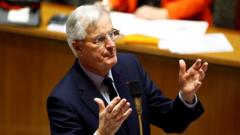
The recent no-confidence vote against Prime Minister Michel Barnier has plunged France into political chaos, raising alarm bells across Europe about the continent's stability in a time of global uncertainty.
In a turning point for French politics, Prime Minister Michel Barnier was ousted after a no-confidence vote led by opposition parties, toppling the government amid economic turmoil and societal unrest. This crisis signals more than just a challenge for French citizens; it poses a significant threat to the broader European Union. Historically, France and Germany have served as the stalwarts of EU power and ideology, but their political instability raises concerns about the bloc's collective strength in facing emerging global challenges.France's current disorder is mirrored by a similar predicament in Germany, where a snap election is due in February following the downfall of the ruling coalition. This simultaneous political malaise in key EU nations undermines the unity that Europe has sought to maintain against external pressures, notably from Russia. The looming threat of reduced military support for Ukraine should Donald Trump regain the presidency in 2024 adds to the region's instability.In this environment marked by uncertainty, the rise of autocratic leaderships in member states like Hungary and Romania exacerbates the situation. With a fragmented parliament in France, President Emmanuel Macron's forthcoming attempts to stabilize governance face substantial hurdles. His strategy to maintain a foothold in the European political landscape appears at risk as legislative gridlock prevents essential reforms and budgetary measures.The economic stakes are equally high, with France's contracting budgetary norms and soaring national debt levels drawing scrutiny from the EU. The potential fallout has implications not only for French taxpayers but also for the eurozone, which depends heavily on the stability of its second-largest economy. As Germany grapples with its industrial stagnation, the repercussions may extend to its eastern European allies who rely on it as a manufacturing powerhouse.For Macron, the political backdrop remains tense. His return from diplomatic negotiations in Saudi Arabia contrasts sharply with the chaos at home. Despite calls for resignation from various political factions that hope to exploit the turmoil to gain power, Macron remains steadfast, denying rumors of early elections. However, the possibility of Marine Le Pen, a recurring figure of French politics with rival claims, capitalizing on Macron's weakness looms large.The overall landscape is fraught with uncertainty. The potential for economic and political shifts could profoundly alter not just France’s future, but that of the wider European Union as leaders grapple with their diminished role on the global stage. As events unfold, the political turbulence within France stands as a pressing concern for all in Europe, igniting debates on stability, governance, and the potential reconfiguration of political power across the continent.


