
In brief
Using X-ray imaging and AI, researchers have virtually "unwrapped" a scroll from the Roman town of Herculaneum, revealing promising text after being burned by the eruption of Mount Vesuvius in 79AD.
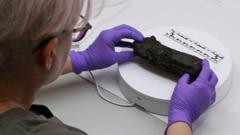
A remarkable scientific advancement has allowed researchers to convert a ravaged artifact from ancient history into a source of knowledge, as they unveil a 2,000-year-old scroll discovered in Herculaneum using cutting-edge technology. Charred by the catastrophic eruption of Mount Vesuvius in 79AD, the scroll, which has remained sealed and fragile for centuries, now offers a glimpse into the past without physical intervention.The project, dubbed the Vesuvius Challenge, utilizes a combination of advanced X-ray imaging and artificial intelligence to virtually "unwrap" the scroll, revealing rows and columns of text hidden beneath its charcoal-like exterior. Stephen Parsons, the project lead, expressed optimism about the team's ability to decipher the ancient text, suggesting it may encompass a philosophical work, with some letters already identifiable.Previously preserved only in theory, the scrolls from Herculaneum – similar to their counterparts in Pompeii – were known to be severely carbonized, rendering them nearly unreadable. Nicole Gilroy, head of book conservation, stated, "We've never been convinced before that any of the techniques would be safe enough or effective enough to get any information from the scrolls," indicating a profound shift brought on by the current technological capabilities.To access the scroll, it was taken to Diamond Light Source in Oxfordshire, where a synchrotron produced high-intensity X-ray beams capable of penetrating the layers of papyrus without causing any damage. The intricate process involved converting those scans into a digital three-dimensional reconstruction, identifying distinct layers of the scroll, and pinpointing text that was nearly indistinguishable from the carbon of the scroll itself.Once the distinct layers were identified, AI algorithms were employed to differentiate the ink from the papyrus, enabling the extraction of text. "We can tell the entire scroll is full of text," Parsons stated with confidence. As the research team continues their work, they aim to reveal not just a few words but potentially significant passages of ancient philosophy.Last year's findings revealed a small portion of another Herculaneum scroll, also thought to focus on Epicurean philosophy, which advocates finding fulfillment in life's simple pleasures. The current project might share a similar thematic focus, but the team is actively calling for further innovation in both human and computational skill to verify this hypothesis.As Nicole Gilroy reflects on the emotional connection to history that this project cultivates, she observes, "There's a real human aspect to it that I just think is really precious." This endeavor holds not only the promise of knowledge but also a pathway that connects our present with the intellectual heritage of our past.