
In brief
The Syrian Identification Centre, led by Dr. Anas al-Hourani, tackles the painstaking process of identifying remains from mass graves, amidst the backdrop of a civil war that claimed countless lives. With limited resources and ongoing trauma for families of the disappeared, experts face a years-long journey ahead.
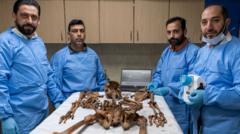
Dr. Anas al-Hourani stands beside two tables displaying an unsettling array of human femurs, part of the newly established Syrian Identification Centre located in Damascus. The sight is haunting; 32 thigh bones neatly arranged and numbered, an initial step in the harrowing process of identifying victims of Syria's brutal civil war, now spanning over 13 years. "These," says Dr. al-Hourani, "are from a mixed mass grave," indicating the horrific manner in which bodies were discarded, piled carelessly atop one another. The tragedy stems from the multitude of casualties accrued under the oppressive regimes of former President Bashar al-Assad and his father, Hafez, who ruled Syria for over five decades. Many bones in these mass graves likely belong to the estimated hundreds of thousands who have perished, with Dr. al-Hourani suggesting these particular remains may belong to victims buried less than a year ago.As a forensic odontologist, Dr. al-Hourani emphasizes the critical information teeth can provide, contributing to the identification process. However, his team faces significant challenges, including only one operational DNA testing facility in Syria, a victim of the civil war's destruction. Due to sanctions, necessary chemicals are unavailable, with many pieces of lab equipment classified as "dual use" and thus restricted. The cost of DNA analysis is another barrier; at $250 for each test, and roughly 20 tests needed to fully reconstruct a single victim, resources are stretched thin. The lab relies solely on funding from the International Committee of the Red Cross.Despite promises of "transitional justice" from the current Islamist-led government, many families search for closure, having lost relatives and knowing little about their fates. The current pace of identification means it could take months for only one victim to be recognized—an arduous process that Dr. al-Hourani notes will unfold over many years.Eleven mixed mass graves are conspicuously scattered around a lonely hilltop outside Damascus, unveiled to the BBC as the first international media present. Here, Hussein Alawi al-Manfi, known as Abu Ali, recounts his former life as a military transporter in Assad's regime. Over the course of a decade, he transported lorry-loads of tortured civilian corpses to hidden burial sites. On average, he made bi-weekly trips during the violence that erupted between 2011 and 2013, with each haul containing between 150 to 200 bodies, unmistakably the victims of state violence, lying mangled in his trailer. Stripped of identity, many cadavers bore only numbers linked to the infamous military detention center, "Branch 215," which we shall revisit.Abu Ali's life took a soul-crushing toll, as he became a mute servant of the state—a reflection of the moral burden carried by those forced to obey, as victims were callously dumped into trenches. As he distanced himself from the gruesome reality of his cargo, he often lost himself among the stars, escaping the horror momentarily.Another poignant story surfaces from Malak Aoude, who recently returned to war-torn Damascus after years in Turkey as a refugee. Though the Assad regime has crumbled, Malak's life remains shackled by the past, marked by the disappearance of her two sons during the conflict.In the years following her sons' abductions, Malak's desperate search for answers only led to heartache. Despite initial optimism that the fall of Assad might signal a chance for her boys' return, she still has no information on their fates. The memories of their suffering—the torture of her youngest son, Mohamad, a teenage boy compelled to join the army— haunt her daily but she is determined to navigate the lingering shadows of loss.As she revisits her son's school, determined to uncover any evidence of Maher's fate, her emotional journey reflects a broader struggle shared by many families who suffered under the Assad regime. With records offering scant hope, Malak remains steadfast in her quest for closure, weeping at the thought of the systemic violence that stole her children and continues to affect countless others. As the Syrian Identification Centre embarks on this monumental task of uncovering buried truths, the resilience of the human spirit shines amidst the heart-wrenching stories of loss and longing that echo throughout the nation.

