
In brief
Amid ongoing impeachment proceedings against South Korea's President Yoon Suk Yeol, supporters are increasingly drawn to conspiracy theories about North Korean and Chinese influences. This growing anti-communist sentiment is reshaping young minds and fueling their fears of a leftist takeover amid a turbulent political landscape.
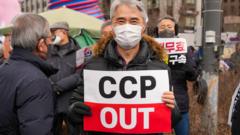
In the chilly air of Seoul, supporters of impeached President Yoon Suk Yeol gathered outside the Constitutional Court, voicing their apprehensions. With chants of "Release him now. Cancel his impeachment," they rallied around the narrative that the opposition desires unification with North Korea, threatening to reshape South Korea into a communist regime. Among these supporters was pharmacy student Shin Jeong-min, articulating a conviction popularized by Yoon's most fervent followers: a belief that left-wing politicians have aligned with North Korean forces in a bid to overthrow the current government.At just 22, Jeong-min represents a new generation drawn into a longstanding fear of communism—a sentiment deeply rooted in the memories of older South Koreans, who endured the Cold War and the harrowing consequences of the Korean War. Over 60 years later, Yoon’s controversial declaration of martial law in December has reignited these fears, with claims of "North Korean communist infiltration" resonating among supporters.Many who had previously dismissed North Korea's threats now find themselves ensnared in a narrative of impending doom. "My country is in crisis," lamented a protestor in his 40s, echoing the sentiments of many who view their democracy as under siege from leftist elements.Yoon has faced accusations of exploiting historical paranoia. The sociology professor, Shin Jin-wook, identifies Yoon's rhetoric as dangerously reminiscent of past dictators. Critics argue that his claims lack evidence and serve only to tarnish the opposition party, employing a divisive strategy that diminishes South Korea's democratic principles.Historically, polarization over North Korea has often driven South Koreans apart. Former leaders used accusations of North Korean sympathizing to stifle dissent, effectively weaponizing anti-communism to justify authoritarian measures. In current times, Pyongyang’s nuclear arsenal and advances in cyber warfare are prominent threats, but the political dialogue has shifted towards fear of China as well, with conspiracies tying Beijing to electoral fraud gaining traction.Polling expert Lee Sangsin underscores how previously fringe theories have been normalized under Yoon's leadership, raising concerns about democracy itself. At rallies, the anti-communist slogans have expanded to incorporate distrust of the Chinese government, reflecting a growing unease with China's influence.The evolution of Yoon's support illustrates how a segment of the populace has undergone a transformation in perception, catalyzed by claims made during martial law. Many supporters no longer see his controversial actions as authoritarian, but rather as necessary steps to shield the nation from a leftist uprising.Young people today, like IT developer Kim Gyung-joo, grapple with complex realities, turning once again to possible communist threats amidst economic uncertainty and housing challenges. This generational shift in fears—from direct dangers posed by North Korea to broader anxiety about China—complicates the historical narrative of inter-Korean relations.Opposition lawmakers remain steadfast in their belief that the tide of panic Yoon has stirred will ultimately subside. "Even with these extreme views spreading, we believe they are unsustainable," asserted Wi Sung-lac of the Democratic Party, insisting that most citizens yearn for a return to democratic norms. Yet with polling showing a slight increase in Yoon's favorability, the division he has created in South Korean society may have lasting implications. Political dynamics are shifting, and as fears of communism intertwine with modern realities of global politics, the legacy of this turbulent period may redefine how South Koreans perceive their democracy moving forward.

