
In brief
The successful launch marks a pivotal moment in China's pursuit of becoming a preeminent space power by 2030.
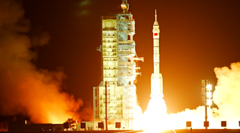
China has proudly announced the successful launch of its Shenzhou 19 spacecraft, carrying a three-person crew that includes the nation's first female space engineer, Wang Haoze. The spacecraft, which docked with the Tiangong space station following a six-hour journey, is set to serve as a base for the crew to conduct various experiments and perform spacewalks during their six-month mission. This endeavor is part of Beijing's broader objective to gain expertise in space exploration as it eyes sending humans to the Moon by 2030.Dubbed a “complete success” by officials, the Shenzhou 19 mission represents one of 100 planned launches during this record year of space exploration for China, aimed at surpassing the efforts of its primary rival, the United States. Media access was granted to the Jiuquan Satellite launch center in Gansu, where the excitement was palpable as flames erupted from the rocket launch pad, illuminating the Gobi Desert amidst enthusiastic cheers from crowds.Upon arrival at the Tiangong space station, the Shenzhou 19 crew joined three other astronauts from the Shenzhou 18 mission, who are scheduled to return to Earth on November 4. President Xi Jinping's vision for space exploration was vocalized just two years ago, emphasizing the commitment to build China into a leading space power, which is perceived with concern by some in Washington. NASA chief Bill Nelson expressed worries earlier this year, stating that the U.S. and China are engaged in a competitive race to the Moon, cautioning about possible territorial claims by Beijing.In towns like Dongfeng Space City, which supports the launch site, excitement for the nation’s space program is evident, with streets adorned in national colors and celebratory events to mark the astronauts' departure. Mission pilot Cai Xuzhe, seasoned in spaceflight, remarked that the crew represents a newer generation of taikonauts born after the 1990s—a combination of youthful zeal and commitment to their country's aspirations.China's recent space achievements include the successful retrieval of lunar samples and the deployment of the Zhurong rover on Mars. The ambition extends beyond exploration, with plans for a vast network of satellites aimed to rival SpaceX's Starlink. This competitive edge, noted even by Elon Musk, raises concerns in Washington regarding the potential militarization of China’s expanding space capabilities.As officials emphasize a stance of peaceful exploration, experts acknowledge the lucrative prospects hidden beneath the Moon’s surface, stirring interest in resource control that adds complexity to the new space race. Meanwhile, the Shenzhou mission's experimental research aims to uncover insights relevant to health conditions on Earth, demonstrating how space exploration yields benefits beyond its immediate reach.Despite aspirations towards lunar advancement, challenges remain. Officials admit that landing a crew on the Moon involves complex technology and a tight timeline, but optimism continues to drive their pursuit. As President Xi prioritizes the space program in light of a slowing economy, a significant rivalry brews beyond the planet’s boundaries, indicating that the future of space exploration may be as contentious as it is ambitious. In an atmosphere of high stakes and profound secrecy, China’s advancements in space are both a source of national pride and a focal point of global tension, as the race between the two world powers unfolds.
