
In brief
The upcoming meeting suggests a complex interplay of negotiations regarding Ukraine's mineral resources and ongoing security issues, highlighting differing perspectives on NATO membership and US support.
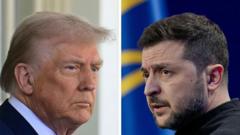
Ukrainian President Volodymyr Zelensky is headed to Washington for an important meeting with US President Donald Trump on Friday, where they are expected to sign an agreement focused on sharing Ukraine's mineral resources. Trump has referred to this bilateral deal as a significant step, although Zelensky has characterized it as preliminary, hoping to build on it with additional security guarantees aimed at deterring further aggression from Russia.During a cabinet meeting, Trump expressed reservations about providing American guarantees beyond a certain limit, placing the onus on Europe to handle security matters concerning Ukraine. Furthermore, Trump seemingly dismissed the possibility of Ukraine joining NATO, which has been a longtime objective of Zelensky's government. "Forget about NATO," Trump stated, suggesting that the presence of US workers engaged in extracting rare earth metals would naturally bolster Ukraine's security.Amid these discussions, Zelensky emphasized the critical need for security assurances, declaring that without them, efforts to establish a ceasefire would falter. He reiterated his desire for either NATO membership or a similar arrangement to ensure Ukraine’s safety.Historically, Russia has opposed Ukraine's potential NATO membership, fearing that it would bring NATO forces close to its borders. Trump has floated the idea of having European peacekeeping troops in Ukraine as part of a ceasefire arrangement, although Russia has rejected such proposals. Discussions involving European representatives, particularly crucial for any peace agreement, have so far excluded them from Washington's talks with Russia.Kaja Kallas, the EU's High Representative for Foreign Affairs and Security Policy, stated that European agreement is essential for any settlement in the region. She insisted that while the minerals agreement is for Ukraine to decide, a broader peace deal must include European backing.The minerals agreement, formally supported by the Ukrainian government this past Wednesday, is anticipated to create an "investment fund" for the country’s reconstruction. This deal signals a tangible prospect for continued US support, a point Zelensky has emphasized since proposing this initiative last year.Discussions regarding this agreement have revealed underlying tensions between Trump and Zelensky, especially after the Ukrainian president previously turned down a US demand for $500 billion in mineral wealth. Recent reports claim this request has been retracted. Diverging narratives around the deal have further complicated their communications, with Trump heralding it as a vast opportunity for the US to recoup investments in Ukraine. In contrast, Zelensky has approached it as a framework for future agreements.As Trump seeks a swift conclusion to the war, he has also aimed to re-establish relations with Russia. Recent communications with Russian President Vladimir Putin have raised concerns, with Zelensky accusing the US of inadvertently helping Putin escape isolation through these dialogues. Meanwhile, access to Ukraine's rich natural resources remains a contentious issue, with estimates indicating that 5% of the world's critical raw materials are located within its borders. Nonetheless, acquiring these resources poses challenges, especially with ongoing territorial disputes and contamination from unexploded mines affecting a significant portion of Ukraine.In a related development, UK Prime Minister Sir Keir Starmer is scheduled to separately meet both leaders in Washington this week to discuss the situation in Ukraine, highlighting the international focus on this complex geopolitical crisis.
