
In brief
Amidst deteriorating conditions in Gaza, the US and Israel have firmly rejected an alternative Arab proposal aimed at safeguarding the Palestinian population in the region post-conflict, standing by a separate reconstruction vision articulated by Trump.
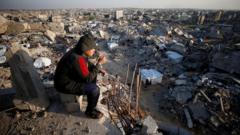
In a striking turn of events, the US and Israel have categorically dismissed an Arab League-backed plan to reconstruct Gaza following a devastating war that has left excessive destruction in its wake. This alternative proposal, presented during a recent summit in Cairo, aims to keep the 2.1 million Palestinians still residing in Gaza within the territory instead of enforcing relocation, a key element of President Trump's controversial plan.The plan proposed by Arab leaders, which has been supported by both the Palestinian Authority and Hamas, seeks a temporary governance model in Gaza led by independent experts, alongside the deployment of international peacekeepers. However, both the White House and Israeli officials quickly rebuffed the suggestion, labeling it inadequate in addressing the current realities faced in Gaza and instead opting to uphold Trump's vision for the region.In the backdrop of escalating tensions and a fragile ceasefire due to expire after six weeks, aid access to Gaza has ground to a halt. Israel's government has utilized this tactic to apply pressure on Hamas, aiming to negotiate a temporary extension of the ceasefire, which includes discussions on the release of hostages versus Palestinian prisoners.The $53 billion Arab reconstruction proposal presented by Egypt at the summit was formulated to facilitate the rebuilding of Gaza in a phased approach over five years. Significantly, it enshrines the principle of non-displacement of Palestinians, condemning any systematic efforts to displace them as a breach of international law.The three phases outlined in the plan offer a structured timeline and budget allocation aimed at assisting the approximately 1.5 million displaced Gazans. From immediate debris clearance to establishing essential infrastructure such as housing and utilities, the Arab League advocates for a transition led by an administrative committee of Palestinian technocrats while paving the way for the eventual reinstatement of the Palestinian Authority.Despite Hamas having taken control of Gaza in 2007, President Mahmoud Abbas of the Palestinian Authority welcomed the Arab initiative. Conversely, both the Israeli foreign ministry and White House officials firmly dismissed the proposal, arguing that it lacks practical measures to address the devastation experienced post-October 7, 2023, when an unprecedented attack from Hamas prompted a swift Israeli military response.Critics of Trump's initiative emphasize that it endorses the forced displacement of Palestinians, which fails to adhere to international legal standards. The Assistant Secretary-General of the Arab League condemned the approach, labeling it a violation of human rights and insisting that such a strategy is fundamentally unjust.With Gaza's population largely displaced and 70% of its infrastructure damaged or destroyed, international aid efforts and humanitarian responses remain direly needed. As conditions continue to deteriorate, fears proliferate regarding a potential recurrence of history reminiscent of the Nakba, during which numerous Palestinians were uprooted from their homes amid the tumultuous establishment of Israel in 1948.In the wake of Israel's military offensive, reports indicate catastrophic humanitarian repercussions, with more than 48,400 individuals losing their lives in Gaza. As the discourse surrounding Gaza evolves on the global stage, the path forward remains fraught with controversy and conflict.
