Warning: This report contains details of physical and sexual abuse and discussion of suicide.
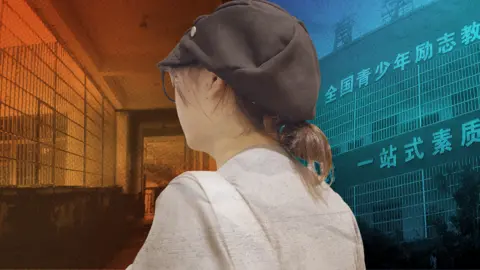
Baobao's heart still races when she smells soil after morning rain. It takes her back to early military drills behind locked gates and the constant fear that marked every one of her days at Lizheng Quality Education School. At age 14, she spent six months in a red and white building in a remote village, where instructors attempted to 'fix' young people branded as rebellious or problematic by their families.
The abuse she endured included severe beatings that left her unable to sit down for days. Baobao, now 19 and speaking under a pseudonym, confided that during her time at the school, she contemplated suicide and knew of others who had attempted it.
A BBC Eye investigation has exposed disturbing allegations of physical abuse across this school and others, revealing numerous cases of young individuals abducted by alleged officials and forced into these institutions. 23 former students provided testimony claiming they were subjected to excessive corporal punishment, some reporting incidents of sexual abuse by instructors. Despite corporal punishment being illegal in China for decades, the accounts paint a grim picture of ongoing violations against students.
These centers profit from the fears of parents worried about their children's behavior, including internet addiction and depression. According to insiders, the financial gains from such institutions can be significant, with annual fees reaching upwards of $25,000 per student.
Under the guise of rehabilitation, Li Zheng, the operator of a network of disciplinary schools, has billowed a smoke screen of legitimacy, only to amass wealth through systematic abuse. Victims like Baobao and another former student, Enxu, who experienced similar horrors, now seek to expose the reality of these institutions to prevent other youths from enduring their fate.
Efforts to curb the operation of such schools have been sporadic at best, with closures often followed by a quick resurgence under new names. Ensuring the safety of adolescents in these institutions has become a pressing issue, as both girls assert that what was marketed as a reform school was essentially a scam: The prevailing educational ethos is one of violence begetting violence, Baobao states, emphasizing the urgent need for reform in these facilities.
Baobao's heart still races when she smells soil after morning rain. It takes her back to early military drills behind locked gates and the constant fear that marked every one of her days at Lizheng Quality Education School. At age 14, she spent six months in a red and white building in a remote village, where instructors attempted to 'fix' young people branded as rebellious or problematic by their families.
The abuse she endured included severe beatings that left her unable to sit down for days. Baobao, now 19 and speaking under a pseudonym, confided that during her time at the school, she contemplated suicide and knew of others who had attempted it.
A BBC Eye investigation has exposed disturbing allegations of physical abuse across this school and others, revealing numerous cases of young individuals abducted by alleged officials and forced into these institutions. 23 former students provided testimony claiming they were subjected to excessive corporal punishment, some reporting incidents of sexual abuse by instructors. Despite corporal punishment being illegal in China for decades, the accounts paint a grim picture of ongoing violations against students.
These centers profit from the fears of parents worried about their children's behavior, including internet addiction and depression. According to insiders, the financial gains from such institutions can be significant, with annual fees reaching upwards of $25,000 per student.
Under the guise of rehabilitation, Li Zheng, the operator of a network of disciplinary schools, has billowed a smoke screen of legitimacy, only to amass wealth through systematic abuse. Victims like Baobao and another former student, Enxu, who experienced similar horrors, now seek to expose the reality of these institutions to prevent other youths from enduring their fate.
Efforts to curb the operation of such schools have been sporadic at best, with closures often followed by a quick resurgence under new names. Ensuring the safety of adolescents in these institutions has become a pressing issue, as both girls assert that what was marketed as a reform school was essentially a scam: The prevailing educational ethos is one of violence begetting violence, Baobao states, emphasizing the urgent need for reform in these facilities.