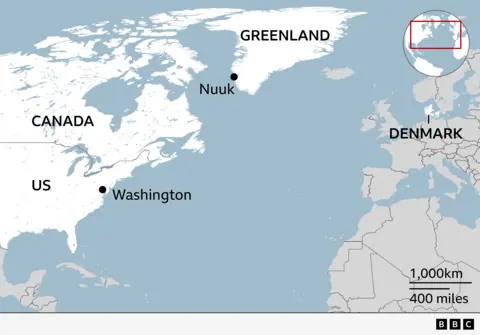
US President Donald Trump has been discussing 'a range of options' to acquire Greenland, including use of the military, the White House said.
The White House told the BBC that acquiring Greenland - a semi-autonomous region of fellow NATO member Denmark – was a 'national security priority.'
The statement came hours after European leaders issued a joint statement rallying behind Denmark, which has been pushing back against Trump's ambitions for the Arctic island.
Trump repeated over the weekend that the US 'needed' Greenland for security reasons, prompting Danish Prime Minister Mette Frederiksen to warn that any attack by the US would spell the end of NATO.
The White House stated: 'The president and his team are discussing a range of options to pursue this important foreign policy goal, and of course, utilizing the US military is always an option at the Commander-in-Chief's disposal.'
NATO is a trans-Atlantic military group where allies are expected to go to each other's aid in case of external attacks.
On Tuesday, six European allies expressed support for Denmark. They stated, 'Greenland belongs to its people, and only Denmark and Greenland can decide on matters concerning their relations.'
The leaders, including those from the UK, France, Germany, and others, stressed the importance of collective security and adherence to international principles regarding sovereignty.
Greenland's Prime Minister Jens-Frederik Nielsen welcomed the statement, calling for 'respectful dialogue'. He emphasized that any negotiation must respect Greenland's status under international law.
This issue resurfaced following US military actions in Venezuela, which raised concerns about American intentions in the Arctic region. Amid these developments, the Trump administration's stance towards Greenland has been characterized by some officials as an official claim of the territory.
Although many residents of Greenland favor independence from Denmark, surveys show significant opposition to being annexed by the US. Comments from local citizens reflect fears over international portrayal and potential military actions by the US administration.
The White House told the BBC that acquiring Greenland - a semi-autonomous region of fellow NATO member Denmark – was a 'national security priority.'
The statement came hours after European leaders issued a joint statement rallying behind Denmark, which has been pushing back against Trump's ambitions for the Arctic island.
Trump repeated over the weekend that the US 'needed' Greenland for security reasons, prompting Danish Prime Minister Mette Frederiksen to warn that any attack by the US would spell the end of NATO.
The White House stated: 'The president and his team are discussing a range of options to pursue this important foreign policy goal, and of course, utilizing the US military is always an option at the Commander-in-Chief's disposal.'
NATO is a trans-Atlantic military group where allies are expected to go to each other's aid in case of external attacks.
On Tuesday, six European allies expressed support for Denmark. They stated, 'Greenland belongs to its people, and only Denmark and Greenland can decide on matters concerning their relations.'
The leaders, including those from the UK, France, Germany, and others, stressed the importance of collective security and adherence to international principles regarding sovereignty.
Greenland's Prime Minister Jens-Frederik Nielsen welcomed the statement, calling for 'respectful dialogue'. He emphasized that any negotiation must respect Greenland's status under international law.
This issue resurfaced following US military actions in Venezuela, which raised concerns about American intentions in the Arctic region. Amid these developments, the Trump administration's stance towards Greenland has been characterized by some officials as an official claim of the territory.
Although many residents of Greenland favor independence from Denmark, surveys show significant opposition to being annexed by the US. Comments from local citizens reflect fears over international portrayal and potential military actions by the US administration.