
In brief
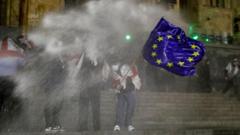
Demonstrators fill Tbilisi’s Rustaveli Avenue, voicing dissent against the Georgian Dream party’s perceived authoritarianism and shift away from European integration, amid police crackdowns and rising tensions.
The streets of Tbilisi have erupted with nightly protests as tens of thousands of Georgians gather to voice their discontent against the ruling Georgian Dream party, which they accuse of aligning with Russian interests at the expense of their nation's European aspirations. The demonstrations have drawn widespread attention, as citizens drape themselves in blue and gold European Union flags, demanding a clear path toward the West.The protests erupted after a series of controversial actions by the government, prompting fears that Georgia is straying from its pro-European trajectory. Prime Minister Irakli Kobakhidze’s announcement that negotiations with the EU would not be considered in the foreseeable future has energized demonstrators. “We’re losing our country,” declared opposition leader Nika Gvaramia, emphasizing the stark choice facing Georgians: a European future or a return to Russian influence.Each night on Rustaveli Avenue, chants, fireworks, and the sounds of vuvuzelas echo through the air as barricades are established between demonstrators and riot police. Clashes have escalated, leading to numerous injuries among both protesters and law enforcement. Lawyers report serious incidents of police violence against detained protesters, leading to calls for accountability from the public defender’s office.Supporting the demonstrators are opposition parties and various civil society groups united in their rejection of the recent elections perceived as fraudulent. Public sentiment is increasingly tinged with desperation; protesters claim the government’s actions mirror Russian tactics to suppress dissent seen in other former Soviet states.With temperatures dropping, the will of the demonstrators shows little sign of waning. While protests have previously shaken this nation of 3.7 million, this current wave appears unprecedented in scale and fervor. In neighboring Russia, officials are closely monitoring the developments, as echoes of Ukraine’s 2014 Maidan Revolution linger in the air.The ongoing crisis poses a challenge for the ruling Georgian Dream party, which maintains its stance of legitimacy from the electoral process while facing mounting calls for new elections. However, moving towards fresh representation under EU supervision remains an unlikely scenario, amidst political tension and a deteriorating relationship with the West.In an environment charged with urgency, protesters vow to continue their fight, determined to ensure that their country remains aligned with the European ideals of democracy and freedom, and firmly reject any return to subjugation under Russian influence. The outcome of these demonstrations will not only shape Georgia's domestic politics but also its future in the context of geopolitical power struggles in the region.

