In brief
An accidental discovery using Lidar technology has unveiled Valeriana, a significant Maya city in Mexico's Campeche region, believed to have been home to thousands of residents. The findings prompt a reevaluation of the richness and complexity of ancient tropical cultures amid challenges like climate change.
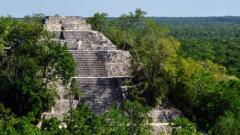
Article text:In a remarkable twist of fate, a PhD student has uncovered a long-lost Maya city hidden beneath the dense jungle foliage of Mexico. The archaeological team, led by Luke Auld-Thomas from Tulane University, stumbled upon the vast city—now named Valeriana—using Lidar technology, a laser survey method that can reveal structures obscured by vegetation.Located in the southeastern state of Campeche, the excavation has revealed a sprawling urban landscape consisting of pyramids, sports arenas, interconnecting causeways, and amphitheaters. Researchers estimate that at its zenith, from 750 to 850 AD, Valeriana may have housed between 30,000 and 50,000 inhabitants—a population density rivaling that of modern times in the area.The discovery was serendipitous; Auld-Thomas accidentally found a Lidar survey while sifting through pages of Google search results. "I was on something like page 16 when I stumbled upon this environmental monitoring laser survey," he recalled. Applying archaeological data processing techniques to the information led him to insights that had slipped past others, revealing the existence of the ancient metropolis.Named after a nearby lagoon, Valeriana defies the preconceived notion that tropical regions were largely devoid of complex societies. Co-author Professor Marcello Canuto emphasized that the findings exemplify culturally rich and complex civilizations, challenging earlier Western paradigms. The reasons for the city's eventual decline are not entirely clear, but the research points to climate change as a significant contributing factor.While no direct images of Valeriana exist, researchers speculate that its architecture bore similarities to other known Maya structures, such as those at Calakmul—located around 100 kilometers away. Valeriana’s urban design featured two main centers, each adorned with grand buildings spaced approximately two kilometers apart, linked by dense clusters of housing and well-constructed causeways.The layout also included residential areas, plazas where residents likely convened for worship and ceremonies, and evidence of a ball court for recreational activities. Auld-Thomas noted the importance of a reservoir that indicated the skillful management of natural resources to sustain a substantial population.In their survey, Auld-Thomas and his team cataloged an astonishing 6,764 structures within an area about the size of Edinburgh, Scotland. Other experts, such as Professor Elizabeth Graham from University College London, echoed the findings, reinforcing the argument that ancient Maya civilization was characterized by interconnected urban centers rather than isolated settlements.The researchers highlighted a grim reality: the collapse of some Maya states around 800 AD was likely linked to unsustainable population densities amid climatic adversities. As drought conditions ensued, the tightly knit societies faced geographical limitations that strained resources, propelling significant demographic shifts.The legacy of Valeriana exemplifies the many uncovered treasures awaiting exploration in the dense jungles of Mesoamerica. The introduction of Lidar technology has transformed archaeological methodologies, enabling researchers to map vast territories previously deemed unyielding. Canuto remarked that this method has allowed more discoveries in the last decade than manual surveys could achieve in the preceding century, hinting at countless more sites yet to be explored.As interest in Valeriana grows, Auld-Thomas acknowledges the challenge of prioritizing which sites can feasibly be excavated given the sheer volume of discoveries. "I've got to go to Valeriana at some point, being so close to the road," he remarked, "but the harsh truth is that we can't excavate them all."This significant research has been published in the academic journal Antiquity, and the story of Valeriana stands as a testament to the enduring mystery of ancient civilizations in the tropical landscapes of Mexico.