
In brief
China's decision to send Vice-President Han Zheng to President-elect Donald Trump’s inauguration marks a pivotal moment in US-China relations, reflecting a desire for constructive dialog amidst growing tensions.
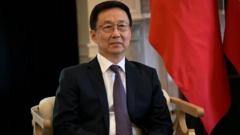
In a notable diplomatic move, China is dispatching Vice-President Han Zheng to the inauguration of US President-elect Donald Trump on January 20, 2025. This will be the first occasion a senior Chinese leader witnesses the swearing-in of a US president. Traditionally, foreign leaders are not present at these ceremonies, however, Trump extended an invitation to Chinese President Xi Jinping, aiming to establish open channels of communication with global leaders, including adversaries.Chinese officials have expressed their aspiration for collaboration with the incoming US administration, seeking to discover a harmonious approach to US-China relations in this “new era.” Nonetheless, they also brace for a potentially contentious Trump presidency, filled with anticipated trade tariffs on Chinese imports and escalating confrontational rhetoric, particularly from key appointments like Marco Rubio, nominee for Secretary of State, whom has labeled China as America’s preeminent adversary.Xi, who has opted to send representatives to similar events internationally rather than attend himself, endorsed the notion of Han Zheng attending the inauguration. Analysts interpret this gesture as an effort to encourage negotiation and foster direct talks with Trump, while strategically maintaining a degree of distance from the proceedings. Neil Thomas from the Asia Society Policy Institute emphasized that although Xi wishes to engage Trump, he seeks to avoid the appearance of being merely a subordinate in the political spectacle.In addition to Han Zheng, invitations have also been extended to several world leaders, including Argentinian President Javier Milei and Italian Prime Minister Giorgia Meloni. Trump's press secretary, Karoline Leavitt, highlighted this outreach as an initiative to forge constructive relations even with nations considered competitors.Reports surfaced of various potential candidates for this diplomatic role, with speculation that Xi’s inner circle, including Cai Qi, was considered for the task. However, insiders suggested that sending someone of Han's vice-presidential rank struck a balance, ensuring that Xi could distance himself from any adverse repercussions stemming from the meeting, specifically if relations were to deteriorate.Han Zheng, appointed as vice-president in March 2023 and previously a key figure in Xi’s political rise, carries significant experience in foreign affairs and economic initiatives, including the Belt and Road Initiative. However, his exclusion from the Politburo Standing Committee suggests a diplomatic strategy of moderation; he is trusted by Xi to represent China without being seen as an extension of the president's core circle.This nuanced approach aims to demonstrate China’s willingness to engage in dialogue while simultaneously protecting the Chinese leadership from the fallout of any potential missteps in US-China relations.

