
In brief
Amidst the relentless chaos of the Gaza Strip, Dr. Wissam Sukkar recounts her daily struggles as a general practitioner striving to provide care while facing an untenable healthcare crisis. With dwindling resources, a surge in displaced patients, and an alarming lack of medical supplies, she highlights the grim realities and emotional toll on both healthcare workers and civilians.
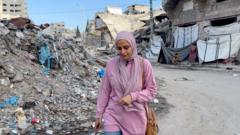
In the midst of the turmoil and destruction in Gaza, the healthcare system stands as a grim testament to the ongoing conflict that has plagued the region for the past 18 months. Dr. Wissam Sukkar, a dedicated general practitioner, describes an unending nightmare as she navigates the devastated streets of Gaza City to continue her work at a Médecins Sans Frontières (MSF) clinic. By 07:30 each day, Dr. Sukkar, adorned in her pink headscarf, embarks on a lengthy 50-minute journey to reach the clinic due to a scarcity of fuel and operational transportation. "With our limited resources, we're still trying to be here in northern Gaza through these difficult times," she reflects, highlighting the determination of her team amid unbearable odds. The World Health Organization (WHO) reports that of Gaza’s 36 hospitals, only 21 are partially functional, as medical supplies face critical shortages due to an ongoing blockade imposed by Israel. Dr. Sukkar points to the remnants of a burns clinic that was devastated early in the war, underscoring the depths of despair and destruction within the healthcare sector.As she dons her white coat by 09:30, she is met with a line of roughly 150 people waiting in a tented reception area. Most patients are displaced, sheltering in makeshift residences or tents. The fallout from a recent ceasefire collapse has once again forced thousands into this neighbourhood, searching for safety. Cases of malnutrition and infection are rising sharply, with children suffering the most severe impacts."Since they are living in close quarters, viruses spread quickly among children,” she notes while treating a toddler with viral infections and a face bruised by mosquito bites. The cessation of cooking gas has forced families to resort to dangerous open flames for meals, leading to a spike in serious burn cases.Within an hour of opening, Dr. Sukkar and her colleagues see dozens of patients, and the weight of the challenges grows heavier. With only rudimentary supplies and an increasing number of complex cases, she admits, "We don't know where to refer these patients because the health system in Gaza has collapsed."A recent Israeli strike on al-Ahli Arab hospital, a crucial trauma care facility, has amplified the already critical situation. Patients who previously relied on al-Ahli for treatment are now flooding into Dr. Sukkar's clinic, often with severe wounds. Among them is Saeed Barkat, an elderly man on crutches, recounting how he was evacuated to various hospitals only to find them subsequently bombed.As midday approaches, Dr. Sukkar nervously checks the clinic's pharmacy, alarmed by the dwindling supplies. The closure of border crossings since March has cut off aid, leaving basic medical needs unmet. "For diabetes, we don't have insulin… No medicines for scabies, head lice—it's alarming," she says, noting that rationing has become essential.After a long day, with nearly 390 patients seen, Dr. Sukkar embarks on the arduous journey home, her mind consumed with worry for her own displaced children—who have faced upheaval nine times in the last 18 months. "Like every Gazan, I'm fighting to provide for my kids... We don’t have electricity to charge our phones," she confesses, her voice tinged with despair."I can't help but feel hopeless," Dr. Sukkar concludes, encapsulating the anguish shared by many. "When will this war end?" In Gaza, for now, the answer remains elusive, wrapped in the shadows of unending conflict.


